


Page 14 - Volume 18 Number 10
P. 14
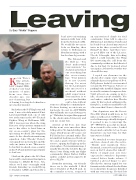
Kevin Ware’sfine article,“Flying intoLAX” (August 2014),evoked a very fondmemory of minefrom over threedecades ago, onenot of arriving, butof leaving Los Angeles behind in a spectacular manner.Back when the F-15 Eagle was still new, I was a freshly-minted First Lieutenant flight lead, one of only two at the time in the 49th Tactical Fighter Wing at Holloman AFB, NM. I was nervous when the wing Director of Operations summoned me to his office to brief him on my cross-country plan for the upcoming weekend. My wingman was to be the other Lieutenant in my squadron, John “Chocks” Pickett, our squadron’s newest pilot and the only one junior to me. This was to be his first weekend cross-country in the F-15 and my first opportunity to lead one.I laid out the plan to the DO: First leg would be instrument/navigation training to MCAS El Toro, CA, where we’d stay overnight with friends. Saturday, we would fly up to Buckley ANGB and then fly alocal air-to-air training mission with four A-7s from the Colorado ANG. We would fly two more 2v4s on Sunday, then return to Holloman on Monday morning, with a low-level nav leg en route.The Colonel said No. Hell no. “You don’t understand your mission,” he declared as he lined out everything but the cross-county legs. “Your mission is to not (screw) this up. I’ve never let two Lieutenants take my jets for a weekend without adult supervision. Your mission is to prove to me that this can be done withoutsomeone calling the command post. No show boating, no air-to-air, no low-levels. Do not do ANYTHING that will make me regret letting you go.” With that, he signed his approval to the skeletonized itinerary and sent me on my way.Arrival at El Toro late that Friday went even smoother than I’d hoped for. We landed with plenty of gas, which was good because our F-15As had no external tanks. The internal fuel load was good for about two and a quarter hours with no reserve, sipping fuel high up in the stratosphere. For maximum range, I usually filed for the low 40s. Except when I was flying with my flight commander, Major Parker. Bubba said he couldn’t get his cigarette lit above FL250.Saturday morning, our friends drove us to the airfield. I filed direct Buckley at FL430 and, in the remarks section, requestedan unrestricted climb for fuel constraints. I was told to expect a SID instead; my Marine buddy said he’d only been cleared unrestricted twice in the three years he’d been flying F-4s there. And there were no good SIDs out of the LA area. Uh-oh, I thought, this is looking tight. I could visualize the Wing DO answering the call from the command post that we had diverted due to low fuel. Or declared a fuel emergency. At least the weather was clear all the way.I copied our clearance in the chocks after engine start, wasting a hundred precious gallons of JP-4. Cell phones hadn’t been invented yet and the F-15 has no battery or parking brake installed. Engine start is via self-contained compressed air. Until at least one engine is up to idle, electrics aren’t available. Nor are brakes – which is how Chocks came by his tactical callsign in the first place, a rather remarkable tale of its own that I leave to him to tell.Our departure was the Desert Five SID, which would leave us 34 miles southeast at 8,000 feet – a real oil burner specifically designed, it seemed to me, to interrupt the 49th TFW/DO’s peaceful weekend. As we taxied to the active, I asked the ground controller to beg Ocean Departure one last time for that unrestricted climb.We switched to tower frequency and were cleared onto the active. “Climb and maintain three thousand, contact Ocean Departure now on 262.7, cleared for takeoff.” Pilots of single-seat jets were expected to switch to departure control before brake release. I twirled a gloved finger to give Chocks the run-up signal for our formation takeoff and checked him in on departure frequency. Satisfied with my own run-up, I looked left12 • TWIN & TURBINEOCTOBER 2014


