


Page 17 - Volume 16 Number 2
P. 17
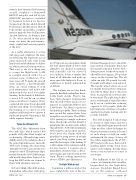
went for dual Garmin G600 systems as well, coupled to a Honeywell KFC225 autopilot and fed by two GNS530W navigators, installed by Lanmar Aviation in Groton, Connecticut. He also added Aircraft Performance Modifications dual aft body strakes, along with a complete interior upgrade done by Executive Aircraft Interiors. As Bonacci puts it, “No other aircraft in this price range can meet the performance, range, comfort and carrying capacity of the 421.”
As a viable alternative to a twin turboprop and or light jet, the later- model Cessna 421 represents a good value and needs only some loving hands and refurbishment to deliver excellent personal transportation. That’s not to say it’s a cheap way to occupy the flight levels. A 421 is complex aircraft with a lot of systems, some of which are 35 or more years old. To make the aircraft work requires a knowledgeable shop, an owner willing to seek good maintenance and a pilot who understands the need for regular training. In the hands of dilettante, a weary 421 can be an accident going somewhere to happen. Every contented 421 owner I’ve spoken with said the same thing; “Don’t skimp on the training, go to school on your airplane and learn how to operate it safely and properly. Operating a 421 safely requires training.”
Flying the Ultimate 421
The 421C flies differently than the early 421s, which carried 300 pounds of flywheel fuel weight on each wingtip. Although wing area is slightly greater, the end-plate effect of the canted tiptanks is gone. Given the 35-lb/sq.ft. loading of its clean wing, 421C pilots need to pay attention to airspeed control. The split-type flaps, retained from the 310/421B heritage, add mostly drag when deployed; to keep the 421C in the air, it must be flown with adequate airspeed.
It’s best to think of the 421C as a less- demanding cabin-class turboprop;
its 375-hp piston powerplants drink less fuel (particularly at low-to-mid altitudes), are cheaper to maintain and generally can be serviced on-condition. It has a similar fuel burn at all altitudes and picks up more speed the higher it’s flown, so endurance is largely independent of altitude.
The engines are not the hand- grenade handfuls unfamiliar know- it-alls freely deride. They’re big- bore turbocharged Continentals that run well if their needs are not ignored; recommended TBO is now 1,600 hours. Yes, there’s a gearcase behind the propeller. That’s nothing new; geared flat engines have been around for over 60 years. The GTSIO- 520’s gearing is a simple reduction drive, which asks only that thrust be maintained in a positive path, rather than allowed to batter the mechanism with negative and positive motion. Don’t drive the engine with the propeller by going power off at high speed, just keep engine power up until the last stages of the landing. If a 421’s engine starts running roughly, for any reason, it requires more immediate attention than a direct- drive engine, just to protect the power train. There’s nothing mysterious about a GTSIO, just differences.
Preflight Walkaround
Beginning a walk-around at the nose, unlatch the rear of the two
left-hand baggage doors to check the gear-system’s hydraulic fluid and the standby nitrogen bottle’s blow- down pressure. Of the 600 pounds of allowable nose baggage, 250 pounds can go in the forward bin. The aft cabin can take 500 pounds, but only if weight-and-balance is monitored. The nacelle wing lockers are good for smaller items and mooring gear; don’t throw sharp, heavy objects in there, because the floor of the locker is structural. The right wing locker’s space and weight is typically taken up by an air conditioner, reducing capacity to 120 pounds, while the left wing locker often has a 28-gallon auxiliary fuel tank, leaving only 40 pounds available.
The well-designed bonded wing is devoid of stall strips and rivet lines; dihedral begins just inboard of the nacelles. A heat exchanger for the pressurization system is located in each wingroot with an outlet underneath the wing; closing off the outlets supplements the 45,000- BTU heater in the nose. Retractable landing lights swing down from under each wingtip; leaving them down costs six knots at cruise if you forget.
The hallmark of the 421 is, of course, its humpbacked nacelles, bequeathed by the high-drive gearcase. Dropdown hinged doors are on the engines’ outboard
FEBRUARY 2012
TWIN & TURBINE • 15
Frank banacci Photo


