


Page 6 - Volume 18 Number 10
P. 6
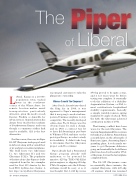
TheLiberal, Kansas is a 20,000- population town, tucked away in the southwest corner of the Wheat State. Its remote location makes aerial transportation particularly attractive, given the need to reach Denver, Wichita or Amarillo for urban services. General aviation has always been vital for the residents of Southwestern Kansas, and even though a commuter airline link may be available, G/A is the best alternative.For this reason, there are six Piper PA-31T Cheyenne turboprops based in Liberal, along with a varied fleet of jet and piston resident airplanes. The field hosts two Cheyenne I’s, two Cheyenne II’s and two Cheyenne II XL’s. The popularity of the fast cabin-class Piper no doubt originated from the two examples used for Part 135 charter by the local FBO, Lyddon Aero Center. A few trips via Lyddon’s Cheyennes4 • TWIN & TURBINEencouraged customers to take the plunge into ownership.Whence Cometh The Cheyenne?After Beech Aircraft introduced the King Air in 1964, it was apparent to Piper’s management that it was going to need a turbine- powered business airplane to stay competitive. The recently-developed cabin-class PA-31 Navajo was the obvious basis for such a design, and in 1966 a contract was let to have Ed Swearingen put Pratt & Whitney PT6A turbines on the prototype Navajo, in order to study its feasibility. It didn’t take long to determine that the Cheyenne project could be a winner.Piper already had a Pressurized Navajo program already well underway, to be powered by massive 425-hp TGIO-541-E1A6 piston engines, so slipping 620-shp PT6A-28 engines onto the P-Navajo airframe would be easy, or so it was thought. But, 1,240 hp versus850 hp proved to be quite a step, and 2 1/2 years went by before testing was complete. It eventually took the addition of a Stability Augmentation System, or SAS, to meet certification’s longitudinal stability requirements, basically a simple variable-tension spring regulated by angle-of-attack. With the SAS, the Cheyenne achieved certification in May of 1972.That timing couldn’t have been worse for the new Cheyenne. The western Susquehannah River overran its banks at Lock Haven, Pennsylvania a month later, in the aftermath of Hurricane Agnes, devastating Piper’s sprawling plant. It took nearly two years to get Cheyenne deliveries going, and eventually the Lock Haven plant was closed, in December 1984; a Cheyenne 1A was the last airplane completed there.The PA-31T Cheyennes come in essentially three variants; the original Cheyenne, with 620-shp -28 engines, which was renamedOCTOBER 2014Piperof Liberal


