


Page 13 - Volume 16 Number 2
P. 13
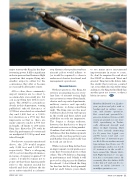
major reasons the King Air has kept its staying power. It fills a significant niche in personal and business flight operations that require flying into smaller airports, either for the convenience they offer or because no reasonable alternative exists.
All too often, these community- airport runways are too short to accommodate even small jets, but can accept King Airs with room to spare. The 200GT is certainly no slouch in this department, touting published takeoff distances of 2,579 feet at sea-level on a standard day and 3,800 feet at a 5,000- foot elevation on a 25°C day. But, impressive as that is, there are many airports under 2,500 feet in length, off limits to 200-series King Airs. Enter the 250, with its three big performance boosters and an unadjusted 12,500-pound max takeoff weight.
For the two scenarios mentioned above, the 250 would require only 2,111 feet and 3,099 feet, respectively. That’s a whopping 22% boost in takeoff performance, in terms of runway required! Of course, I would be remiss not to point out that these figures purely refer to the runway needed for takeoff and don’t address the far more safety-minded accelerate-
stop distance that prudent turbine aircraft pilots would adhere to (or would be required to observe under most charter, fractional, and management operations).
Measured Success
Without question, the King Air series is an amazing success story. Any line of aircraft seeing high success rates in owner-flown hands, charter and corporate departments, military service and specialty applications, is doing something right. The King Airs are the most widely-produced twin turboprops in the world and their safety and reliability records are impressive. The longer a design endures, however, the harder it is to keep it relevant in an ever-evolving market. Combine that with the economic turbulence that has shaken up much of the world over the past few years and Hawker Beechcraft really has its work cut out for it.
While every new King Air has been an improvement over its predecessor, some have been much more so than others. The 250 delivers a big jump in performance and I think it will prove to be a big success for Hawker Beechcraft. I don’t think the King Air line has hit the developmental wall yet and I believe you’re likely
to see many more incremental improvements in years to come. So, don’t be surprised to read about the 250GT or other such “latest and greatest” King Air in the future. Like the starlet that everyone counted out, even while she was still wowing a u d i e n c e s , t h e K i n•g A i r l i n e l i k e l y h a s another great act (or two, or three) left in its career. T&T
Matthew McDaniel is a 22-plus- year professional pilot with a background in airline, corpo- rate, and charter operations. He’s owned and operated Pro- gressive Aviation Services, LLC (www.progaviation.com) since 2002, specializing in Techni- cally Advanced Aircraft and Glass Cockpit training. Matt has been actively instructing for 20 years, has logged over 12,500 hours total and over 4,500 hours of instruction-giv- en. He holds six turbine aircraft type-ratings, has flown over 70 aircraft types, and is one of only 26 instructors in the world to have earned the “Master Certi- fied Flight Instructor” recogni- tion five consecutive times. He currently flies the Airbus A320 in his ‘day job’ and can be con- tacted at (414) 339-4990 or matt@progaviation.com.
FEBRUARY 2012
TWIN & TURBINE • 11


